
The Youth Advocates for Climate Action Philippines (YACAP) expresses its concern and frustration over the tragedy that happened on Thursday, where the Philippine Coast Guard (PCG) reported a Philippine-flag vessel ‘MT Terranova’ with 1.4 million liters of industrial fuel oil capsized and sank off the coastal waters of Limay, Bataan. The casualties are currently being monitored including a crew member that died. The vessel went down due to the heavy rains brought by Typhoon Carina and the southwest monsoon in recent days.
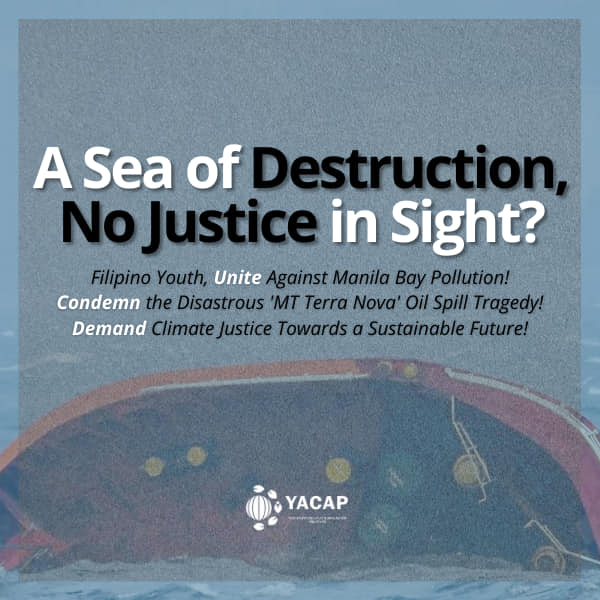
We strongly condemn the inactions which led to such devastating consequences as it wrecks the current state of our environment. Those that are affected, especially the fisherfolk shall be compensated for their daily living, hold accountability, and address the tragedy so as to manage further impacts on the marine ecosystem and our climate.
The oil spill was detected at about 3.7 kilometers going northeast, and the authorities have now been preparing to procure dispersants and floating barriers to contain further slicking. A probable method of siphoning the tanker is possible to prevent further leaking.
The Manila Bay is in great peril as these fossil fuels, that of crude oil contaminates our environment, the water, and even air. Companies drill and pump crude oil from the ocean floor, and are then being transported by pipes and ships in the seas to the processing plants–refineries. Agencies and the authorities will come to calculate the likely cost of damage, but one must be held accountable for all the devastation. This profit-driven industry has done more harm than good as more spills are reported when drilling fossil fuel proliferates. The only way to mitigate the harmful effects of catastrophic oil spills is to stop drilling it.
In the event of an oil spill, sea life is compromised. Be it fishes, sea birds, and other marine animals can become affected through poisoning and suffocation. Shrimps and shellfish could become fatal if contaminated with oil at concentrations of 1-3 mg/l for more than four days. Those that are thriving close to the surface that needs to feed or breathe are the most at stake. Feathers of sea birds could become drenched with oil affecting their ability to regulate body temperatures as well as their buoyancy, thus drowning. Ecosystems are disrupted as breeding and reproduction could become contaminated in the case of turtles offshore. Planktons are also likely to be hit as photosynthesis could become blocked because of the murky waters. Impacts to local economies and tourism, that of the fisherfolk whose livelihood comes from the seas are heavily impacted as restrictions in fishing are imposed leaving the fisherfolk with no alternative.
It is apparent that the government has made it clear, no urgent actions have been brought to the light of day ever since the beginning of term. The inaction to allow dangerous fossil fuels to operate inflicts suffering on the livelihood and environment. In order to clean up the oil spill, usually the government uses dispersants to break down particles of oils, and some of it might have impending impacts to marine life. Albeit, dispersants today are less toxic, as it disintegrates large amounts of oil, droplets reaching seafloor could be consumed by organisms and become bioaccumulated in seafood. Other methods used are booms and skimmers which are barriers placed around and vacuums or sponges made of rope or even human hair that are placed in permeable sacks as improvised booms to absorb oil from the water.
It can be recalled in 2006 when the Guimaras oil spill happened, the Philippine Coast Guard revised the National Oil Spill Contingency Plan (NOSCOP) to manage spill response through adopting tiers depending on the magnitude of oil spill, proximity, and number of resources required to respond in to the situation. Currently, there are three tiers in the said plan.
It is also advisable to wear personal protective equipment (PPE) since crude oil irritates the skin and could lead to inflammation. It is also recommended by the United States National Institute of Health (NIH) for people to have respirators when doing cleanups and tape their boots and pants.
Lastly, for the people living near the contaminated areas, they are reminded to be mindful of slips and falls when handling debris that are covered in oil, do not come in contact with unknown substances (liquids), and do not touch unmarked containers.
It is undeniable that the destructive effects of oil spill are insurmountable. The YACAP calls for the proprietor of the MT Terranova and those involved, should be held accountable and liable for the damage, thus claiming responsibility. With the ongoing climate crises, we call the government to take a firm stance with regards to fossil fuels and its detrimental impacts to the people and environment. We call for accountability to address the tragedy with a sense of urgency to resolve the issue.
This is not the only case that happened this year. Hence, a tragedy of the commons.
 Youth Advocates for Climate Action Philippines